
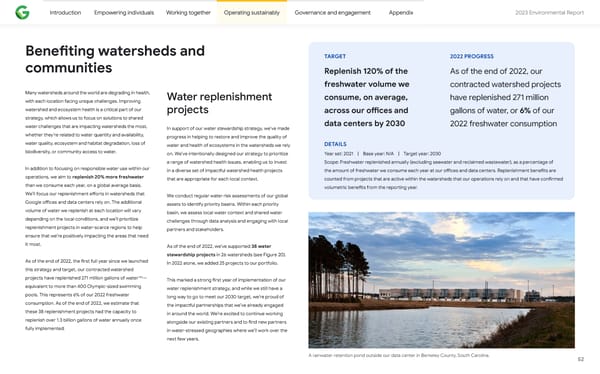
Introduction Empowering individuals Working together Operating sustainably Governance and engagement Appendix 2023 Environmental Repo爀琀 Bene昀椀ting watersheds and TARGET 2022 PROGRESS communities Replenish 120% of the As of the end of 2022, our freshwater volume we contracted watershed projects Many watersheds around the world are degrading in health, consume, on average, Water replenishment have replenished 271 million with each location facing unique challenges. Improving watershed and ecosystem health is a critical pa爀琀 of our projects across our o昀케ces and gallons of water, or 6% of our strategy, which allows us to focus on solutions to shared data centers by 2030 2022 freshwater consumption water challenges that are impacting watersheds the most, In suppo爀琀 of our water stewardship strategy, we’ve made whether they’re related to water quantity and availability, progress in helping to restore and improve the quality of water quality, ecosystem and habitat degradation, loss of DETAILS water and health of ecosystems in the watersheds we rely biodiversity, or community access to water. on. We’ve intentionally designed our strategy to prioritize Year set: 2021 | Base year: N/A | Target year: 2030 a range of watershed health issues, enabling us to invest Scope: Freshwater replenished annually (excluding seawater and reclaimed wastewater), as a percentage of In addition to focusing on responsible water use within our in a diverse set of impac琀昀ul watershed health projects the amount of freshwater we consume each year at our o昀케ces and data centers. Replenishment bene昀椀ts are operations, we aim to replenish 20% more freshwater that are appropriate for each local context. counted from projects that are active within the watersheds that our operations rely on and that have con昀椀rmed than we consume each year, on a global average basis. volumetric bene昀椀ts from the repo爀琀ing year. We’ll focus our replenishment e昀昀o爀琀s in watersheds that We conduct regular water risk assessments of our global Google o昀케ces and data centers rely on. The additional assets to identify priority basins. Within each priority volume of water we replenish at each location will vary basin, we assess local water context and shared water depending on the local conditions, and we’ll prioritize challenges through data analysis and engaging with local replenishment projects in water-scarce regions to help pa爀琀ners and stakeholders. ensure that we’re positively impacting the areas that need it most. As of the end of 2022, we’ve suppo爀琀ed 38 water stewardship projects in 26 watersheds (see Figure 20). As of the end of 2022, the 昀椀rst full year since we launched In 2022 alone, we added 25 projects to our po爀琀folio. this strategy and target, our contracted watershed 102 projects have replenished 271 million gallons of water — This marked a strong 昀椀rst year of implementation of our equivalent to more than 400 Olympic-sized swimming water replenishment strategy, and while we still have a pools. This represents 6% of our 2022 freshwater long way to go to meet our 2030 target, we’re proud of consumption. As of the end of 2022, we estimate that the impac琀昀ul pa爀琀nerships that we’ve already engaged these 38 replenishment projects had the capacity to in around the world. We’re excited to continue working replenish over 1.3 billion gallons of water annually once alongside our existing pa爀琀ners and to 昀椀nd new pa爀琀ners fully implemented. in water-stressed geographies where we’ll work over the next few years. A rainwater retention pond outside our data center in Berkeley County, South Carolina. 52
 2023 Environmental Report Page 51 Page 53