
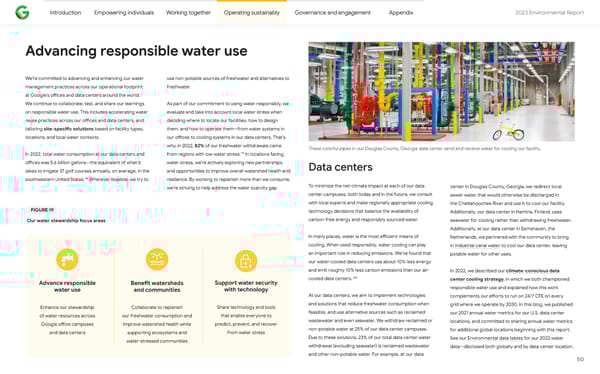
Introduction Empowering individuals Working together Operating sustainably Governance and engagement Appendix 2023 Environmental Repo爀琀 Advancing responsible water use We’re commi琀琀ed to advancing and enhancing our water use non-potable sources of freshwater and alternatives to management practices across our operational footprint freshwater. at Google’s o昀케ces and data centers around the world. We continue to collaborate, test, and share our learnings As pa爀琀 of our commitment to using water responsibly, we on responsible water use. This includes accelerating water evaluate and take into account local water stress when reuse practices across our o昀케ces and data centers, and deciding where to locate our facilities, how to design tailoring site-speci昀椀c solutions based on facility types, them, and how to operate them—from water systems in locations, and local water contexts. our o昀케ces to cooling systems in our data centers. That’s why, in 2022, 82% of our freshwater withdrawals came These colo爀昀ul pipes in our Douglas County, Georgia data center send and receive water for cooling our facility. 99 In 2022, total water consumption at our data centers and from regions with low water stress. In locations facing o昀케ces was 5.6 billion gallons—the equivalent of what it water stress, we’re actively exploring new pa爀琀nerships Data centers takes to irrigate 37 golf courses annually, on average, in the and oppo爀琀unities to improve overall watershed health and 98 southwestern United States. Wherever feasible, we try to resilience. By working to replenish more than we consume, To minimize the net-climate impact at each of our data center in Douglas County, Georgia, we redirect local we’re striving to help address the water scarcity gap. center campuses, both today and in the future, we consult sewer water that would otherwise be discharged in with local expe爀琀s and make regionally appropriate cooling the Cha琀琀ahoochee River and use it to cool our facility. FIGURE 19 technology decisions that balance the availability of Additionally, our data center in Hamina, Finland, uses carbon-free energy and responsibly sourced water. seawater for cooling rather than withdrawing freshwater. Our water stewardship focus areas Additionally, at our data center in Eemshaven, the In many places, water is the most e昀케cient means of Netherlands, we pa爀琀nered with the community to bring cooling. When used responsibly, water cooling can play in industrial canal water to cool our data center, leaving an impo爀琀ant role in reducing emissions. We’ve found that potable water for other uses. our water-cooled data centers use about 10% less energy and emit roughly 10% less carbon emissions than our air- In 2022, we described our climate-conscious data 100 cooled data centers. center cooling strategy, in which we both championed Advance responsible Suppo爀琀 water security Bene昀椀t watersheds water use and communities with technology responsible water use and explained how this work At our data centers, we aim to implement technologies complements our e昀昀o爀琀s to run on 24/7 CFE on every and solutions that reduce freshwater consumption when grid where we operate by 2030. In this blog, we published Share technology and tools Collaborate to replenish Enhance our stewardship feasible, and use alternative sources such as reclaimed our 2021 annual water metrics for our U.S. data center that enable everyone to our freshwater consumption and of water resources across wastewater and even seawater. We withdraw reclaimed or locations, and commi琀琀ed to sharing annual water metrics predict, prevent, and recover improve watershed health while Google o昀케ce campuses non-potable water at 25% of our data center campuses. for additional global locations beginning with this repo爀琀. suppo爀琀ing ecosystems and from water stress and data centers Due to these solutions, 23% of our total data center water See our Environmental data tables for our 2022 water water-stressed communities withdrawal (excluding seawater) is reclaimed wastewater data—disclosed both globally and by data center location. and other non-potable water. For example, at our data 50
 2023 Environmental Report Page 49 Page 51